
by Michael Weileder, winter term 2024/2025
Photoacoustic or opto-acoustic non-destructive testing typically uses short-pulsed electromagnetic radiation (mostly lasers) as probing energy, while detecting ultrasound generated by thermoelastic expansion due to photon absorption.[4]
History
The photoacoustic effect was firstly used by the “Photophone”, an optical telephone, built by Bell in 1880. The then called light-induced “sonorous” effect used by the Photophone was then studied more intensively and led to opto-acoustic gas analysers, built by Veingerov in 1938. The field of opto-acoustic gas analysers was then superseded by the more sensitive gas chromatography. But with the development of the laser in 1960, there was yet another revival in opto-acoustic gas analysis. While the gas-microphone method used in opto-acoustic gas analysers is efficient in detecting low-frequency sound vibrations produced by chopped light beams, the detection of high-frequency ultrasound vibrations produced by short-pulsed radiation sources was possible with the usage of piezoelectricity. So, the photo-acoustic effect could be used in the field of ultrasonic testing.[4]
Physical basics
The opto-acoustic effect relies on electromagnetic waves (most commonly lasers, but also X-rays, microwaves, and other optical source) to induce localized heating on a sample’s surface, leading to thermoelastic expansion and subsequent wave generation (see Figure 1).
|
Figure 1: Schematic representation of an ablative opto-acoustic measurement, |
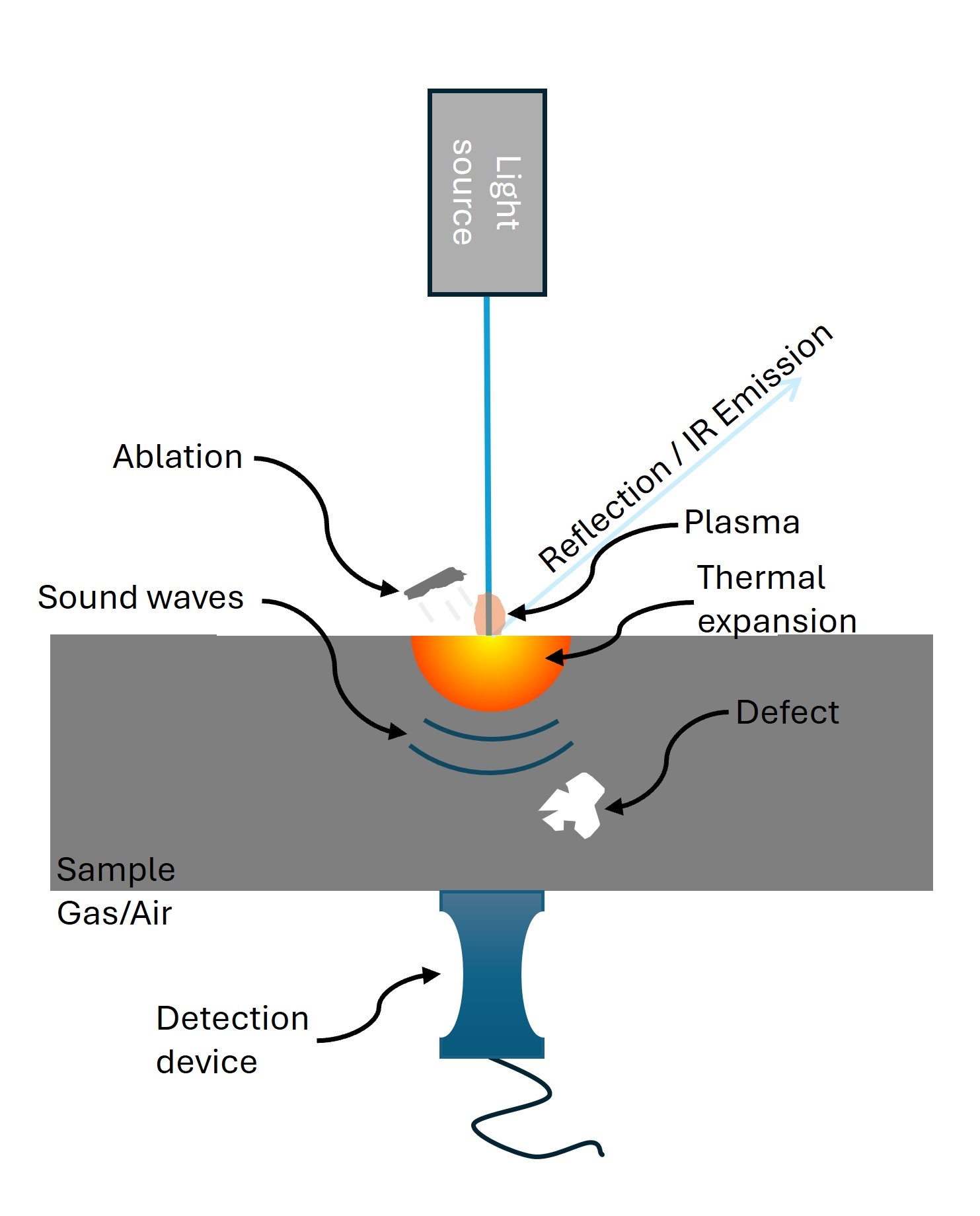
The following thermal expansion of the medium produces stresses and strains in various directions. These stresses and strains are the source of elastic waves in the medium, which can be detected. Important parameters for the generation of elastic waves are i.e.: absorption of the used electromagnetic waves wavelength, the intensity of the electromagnetic waves, focal length, illumination angle and the thermal conductivity of the medium.[5]
Scherleitner describes the sound-source as a wide in-plane disc-shaped area parallel to the illuminated surface. The size of this area depends on the spot-size of the light source and can be in the range of several millimeters down to tens of micrometers.
This shape leads to a direction of the compression waves (p-waves) of around 65° to the surface-normal-vector , shear waves(s-waves) are given off in about 30° off-axis.[5]
One big advantage of the opto-acoustic effect is, that the energy source does not need to have contact with the sample to generate elastic waves in the medium. With the right receivers the whole testing method can be contact-less. Another advantage is the usage of chopped or pulsed electromagnetic waves. Using chopped or pulsed electromagnetic waves the exploitable bandwidth of the elastic waves is not restricted. Wissmeyer mentions, that frequencies up to hundreds of MHz can be achieved. For this application, lasers a mostly used.[7] Their exceptional degree of controllability and high intensity makes them almost a perfect match for generation of ultrasound using ultra short pulses (down to couple of ns).
Manohar and Razansky[4] state an expression (Equation 1), which describes a Gaussian spreading of the heat in the sample after a finite-duration pulse. To showcase that the introduced energy decays exponentially whilst being efficiently converted to acoustic waves.[4]
$q(x,t) = \frac{T_1 - T_0}{\sqrt{\pi t}} \cdot \exp\left(-\frac{x^2}{d_0^2}\right)$ Equation 1
With
x=location
t=time
T_0= starting\;temperature
T_1=heated\;temperature
d_0=√(4Dt_p )=thermal\; diffusion\; length
D=thermal\; diffusivity\; of\; the\; sample
t_p=pulse\; duration
The thermal diffusion length d_0=√(4Dt_p ) quantifies the distance over which a temperature disturbance propagates into a medium.[6]
If the pulse-duration may be chosen too short, the thermal diffusion lengthd_0, may be smaller than the resolution of the sensing system. This means that the pressure rise is too low to be sensed. In the other case, the pressure rise may be too high, so destruction can occur. Manohar and Razansky[4] state the pressure rise as:
∆p_0=ΓE_a where Γ=Grüneisen \;coefficient,\;E_a=absorbed \;Energy[4]
The Grüneisen coefficient is a dimensionless parameter that combines the thermal expansion coefficient, compressibility, and speed of sound of the material/sample.[4]
One disadvantage of the non-ablative/non-destructive or thermoelastic opto-acoustic regime is the low sound pressure produced in the sample. So, the signal to noise ratio can be improved by averaging (Scherleitner[5] mentions hundreds to thousands) or try to achieve stronger signals in the sample. To get stronger signals in the sample, more energy needs to be introduced. This can be achieved by higher light-intensities, better absorption on the surface and a smaller focal length. But the introduced energy can be too high. In fluids this can lead to evaporation, in solids the pressure rise can be too drastic and the following stresses can be over the damage threshold and can lead to damage/ablation.[5]
In ablation, the surface of a sample is heated so intensely that a plasma is generated and chunks may be shattered away. [1]
If higher ultrasonic amplitudes are needed, the pressure waves need to be more perpendicular to the surface and/or the sample surface is not too sensitive mostly the ablative regime can be chosen. (As a rule of thumb, most metals vaporize instantaneously at 10^7W/cm^2)
The particles slinging back and the plasma, give of a pushback on the surface of the sample, causing pressure waves propagating into the sample. The produced soundwaves are independent of the illumination angle of the light source, which can further simplify the measurement. In the ablative regime p-waves are introduced mostly at 90° to the surface normal and s-waves usually are around 30-60°. Scherleitner[5] also mentions, that the ablation has negligible impact on the stability of the pulses and the surface overall.
Implementation in non-destructive testing
The light source and the following thermal expansion/sound can be seen as the transmitter of every opto-acoustic measurement method. Typical receivers used with the opto-acoustic effect are piezoelectric receivers (similar to ultrasonic testing), microphones (similar to acoustic testing) or optical receivers (Interferometers, photo elastic receivers).[5]
Opto-acoustics are mostly used in medical and industrial applications. Depending on the use case the suitable light-source and receiver must be chosen.
One example in for the medical application can be the opto-acoustic imaging, where light pulses are used to further enhance the ultrasonic imaging by showing specific biomolecules, like haemoglobin, collagen, melanin, water or lipids.[3]
Both the sensor head and the signal transmission can be purely optical, making them immune to strong electromagnetic fields. Which allows them to be used in MRIs.[8]
In industrial applications opto-acoustics are being used to scan for defects, like in silicon chips/small film objects[4], or metals[5]. Laser acoustics can also be used for checking physical material models, training for good/bad evaluations or can simply used on difficult to access surfaces, hot surfaces or surfaces where contamination is not allowed.[2]
Bibliography
- Chemie.de (2025): Ablation (Physik). Online verfügbar unter https://www.chemie.de/lexikon/Ablation_%28Physik%29.html
- Fraunhofer Institute for Material and Beam Technology IWS (2025): Laser Acoustic Test System LAwave® - Fraunhofer IWS. Online verfügbar unter https://www.iws.fraunhofer.de/en/technologyfields/pvd_nanotechnology/coating_characterization/lawave.html
- iThera Medical (2024): Technology | iThera Medical. Online verfügbar unter https://ithera-medical.com/technology/
- Manohar, Srirang; Razansky, Daniel (2016): Photoacoustics: a historical review. In: Adv. Opt. Photon., AOP 8 (4), S. 586. DOI: 10.1364/AOP.8.000586.
- Scherleitner, Edgar; Reitinger, Bernhard; Hettich, Mike; Berer, Thomas; Burgholzer, Peter (2019): Handbook of Advanced Non-Destructive Evaluation. Cham: Springer (Springer eBook Collection). Online verfügbar unter https://link.springer.com/content/pdf/10.1007/978-3-319-30050-4_51-1.pdf.
- Toshimasa Hashimoto (2017): Temperature Wave Analysis. In: SCIENTIFIC INSTRUMENT NEWS (Vol 9).
- Wissmeyer, Georg; Pleitez, Miguel A.; Rosenthal, Amir; Ntziachristos, Vasilis (2018): Looking at sound: optoacoustics with all-optical ultrasound detection. In: Light Sci Appl 7 (1), S. 53. DOI: 10.1038/s41377-018-0036-7.
- Xarion laser acoustics (2017): Advantages, 02.02.2017. Online verfügbar unter https://xarion.com/de/technologie/vorteile
Überblick
Inhalte
Aufgabenbericht

 Der Inhalt ist verfügbar unter der Lizenz a Creative Commons Namensnennung-Nicht kommerziell 4.0 International Lizenz.