Background:
Lattice Gauge Theories (LGTs) provide a discretized framework for studying fundamental interactions in high-energy physics, enabling numerical simulations of phenomena such as confinement and symmetry breaking. While classical algorithms can handle small systems, the exponential growth of the Hilbert space quickly makes large-scale simulations intractable.
Quantum algorithms—particularly the Variational Quantum Eigensolver (VQE)—offer a promising route for determining ground states of LGT Hamiltonians. VQE combines a quantum processor for state preparation and measurement with a classical optimizer to minimize the expectation value of the energy. Implementing such algorithms on actual hardware not only tests their practical viability but also provides insight into the role of noise and the effectiveness of error mitigation schemes.
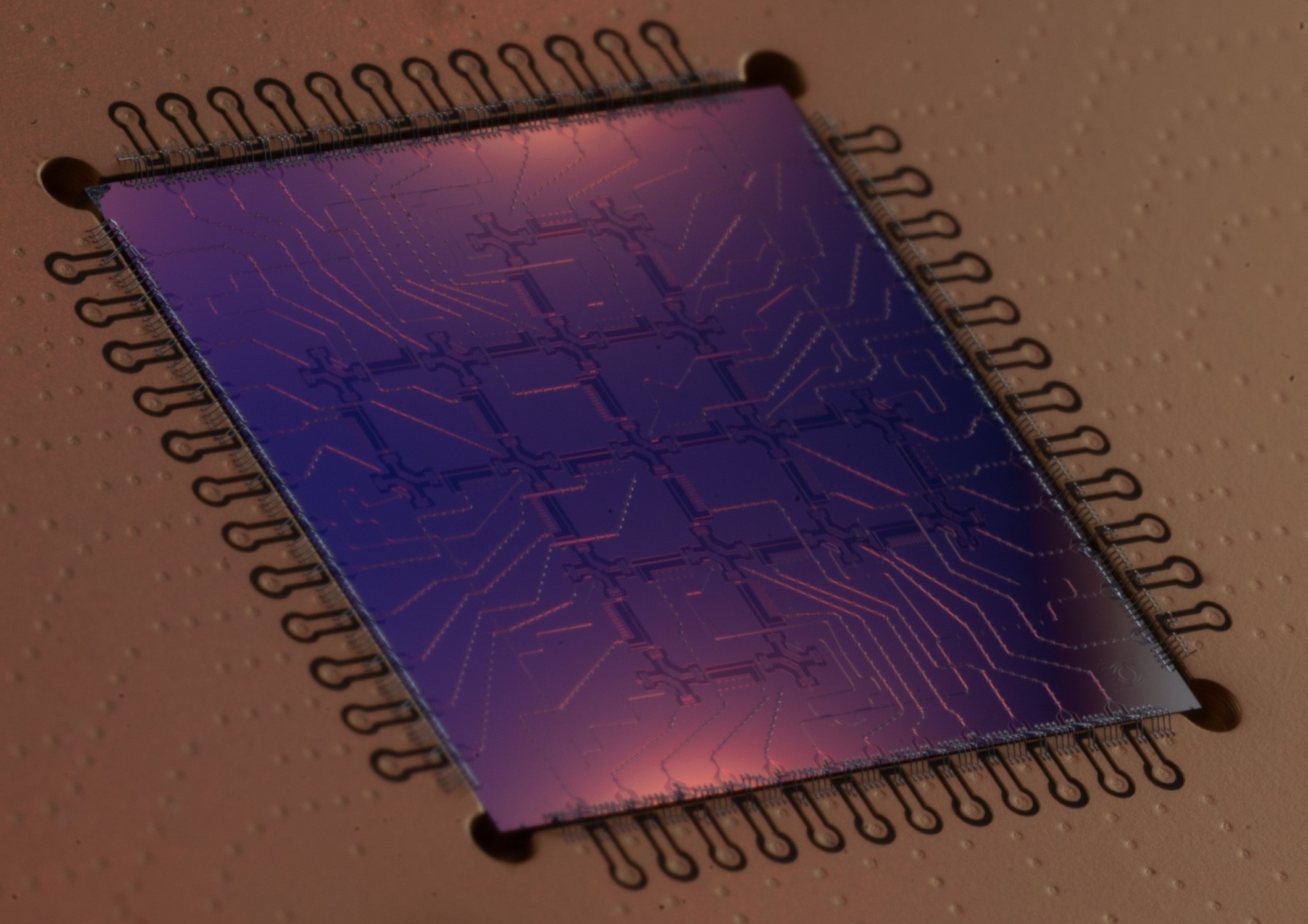
This project will focus on a small LGT instance, using a minimal lattice size to capture key physics while remaining within the reach of current quantum hardware. The implementation will be done on the mid-scale quantum processors at the WMI laboratory, accessed directly through the laboratory’s cloud platform.
Tasks:
The project comprises three parts:
1. Theoretical Background and Algorithm Design
o Review the basics of lattice gauge theory, focusing on the Hamiltonian formulation
o Learn the structure and workflow of the VQE algorithm, including ansatz design and classical optimization strategies.
2. Classical Simulation and Benchmarking
o Implement the chosen LGT model and VQE algorithm on a classical simulator.
o Benchmark performance across different ansatz circuits, measuring accuracy, convergence speed, and resource requirements.
3. Experimental Implementation on WMI Quantum Hardware
o Translate the VQE workflow to run on the QPU via the WMI cloud interface.
o Characterize gate performance, calibration requirements, and system-specific constraints.
o Explore error mitigation strategies (e.g., measurement error correction, zero-noise extrapolation) to improve result fidelity.
Outcome:
The project will deliver a fully implemented VQE workflow for a small LGT instance, validated both in simulation and on real quantum hardware. The experimental results will provide benchmarks for algorithm performance under realistic noise and will inform future scaling of LGT algorithms on superconducting qubits.