Base tour mode choice
The tour mode choice model is a discrete choice model based on utility maximization. The base tour mode choice model predicts the share of tours performed by each mode.
Modal utilities are expected to differ by tour purposes. Hence, individual models were estimated for the following tour purposes:
- Mandatory: Work + Education
- Discretionary: Accompany
- Discretionary: Other
- Discretionary: Shop
- Discretionary: Recreation
The models were based on weekly trip diary data collected by the German Mobility Panel (MoP). The German Mobility Panel conducts household travel surveys yearly following the same households to study household travel behavior and car usage. The survey can be accessed from the German Mobility Panel's website.
Model specification
Data analysis of the MoP data showed that very few tours were conducted with more than one mode. Therefore, tour mode choice chooses a simplified main tour mode that is applied to all legs of a tour.
Choice is modeled among the following modes:
- Auto driver
- Auto passenger
- Train (sub-urban and regional)
- Tram or Metro
- Bicycle
- Bus
- Walk
Utilities of each mode are assessed in terms of the following attributes:
| Person attributes | Household attributes | Tour related attributes | Transport supply related attributes |
|---|---|---|---|
| Age | Household size | Number of stops on the tour | Generalized cost (travel time + travel cost in minutes) |
| Gender | Number of autos | Tour purpose | |
| Possession of driver's license | Number of children | Tour frequency | |
| Mobility restrictions | Household location region type | ||
| Main commute mode |
A nested logit model structure is adopted for this model to account for similarities between modes. Different nesting structures were tried until adopting the following nesting structure:
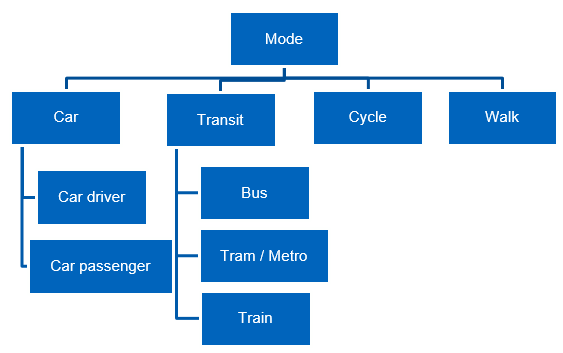
Model estimation
The estimation was conducted using the Apollo package (1), an R extension package built for estimating and applying choice models. The estimations were carried out on the MoP datasets for years 2016 - 2020.
The general steps for estimation were:
1.) Defining the Generalized Cost (GC):


2.) Estimating by purposes:
Sequentially add alternative specific generalized cost, tour specific, socio-demographic and spatial attribute variables while avoiding significant correlation between independent variables.
3.) Estimated models
The detailed specification of the estimated mode choice models can be found here: tour_mode_choice_model_wiki.pptx
Model source code:
(1) http://www.apollochoicemodelling.com/
(2) Value Of Time: reference