




General information on the AQT user operation
Overview
After having operated the AQT system at LRZ during the Friendly User Pilot Phase, we want to transition to the regular user operation of the system and thus establish a new service for the MQV users at LRZ. In the following, the main parameters for its operation are described.
Users of the system and access model
Every researcher with a scientific affiliation in an institution which is part of MQV is entitled to access the AQT system. The researchers can submit their project proposals immediately, the access to the system will be granted starting from August 27, 2025.
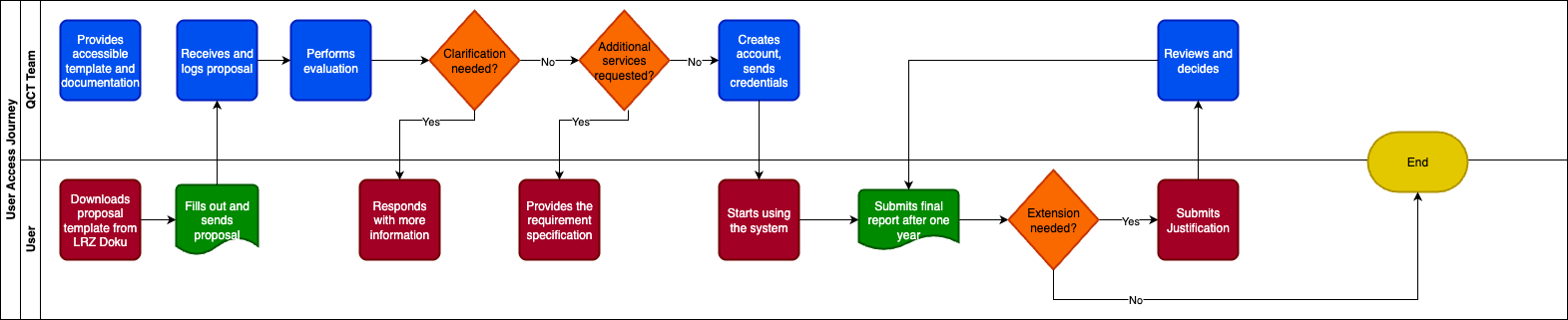
Although the access is affiliation-based, we ask the researchers to fill our proposal template, to be downloaded here: LRZ project proposal template. This will help the LRZ team to get an understanding of the use cases run on the quantum computer and, on the long run, to adapt our services to the needs of the user community. The evaluation of the proposals will not be a precondition to access the system. The researchers who got access during the Friendly User Pilot Phase keep their access granted, but they are asked to fill and submit the proposal template as well, by September 30th. They may use the same data as in the proposal or final report of the Friendly User Pilot Phase, provided these are still relevant to the research planned during regular user operation.
The duration of each project is set to one year, with the possibility of applying for extensions, by submitting the one-year final report and providing justification. A graphics representing the user journey in applying to system access and using it is reported below.
Computing unit and priority on the system
The definition of the unit of measurement for the computing resources on the QC systems at LRZ, the equivalent qubit-second, can be found here: Definition of the computing unit for the LRZ Quantum Systems. Important: the usage of the AQT system will not be charged to the users based on a computing budget, however the processing of jobs will be based on a fair scheduling scheme, where jobs from users who consume more resources have lower priority.
Operation schedule of the system
Similar to the Friendly User Pilot Phase, the system is operated in a supervised mode from Mondays to Wednesdays, 9:00 to 17:00. During these intervals, personnel from AQT remotely monitors the status of the system and can intervene to restore the operation, if any disruption occurs. Outside these intervals of time the system is operated in unsupervised mode: this means that the system is available to users with its nominal performance but, if anything disrupts the system during the unsupervised times, the system goes offline and is brought back to operation during the next supervised phase. On Thursdays upgrades and other maintenance operations are performed and the system can be unavailable.
The system will not be operated in priority slots for given research teams, as it was done during the Friendly User Pilot Phase.
Communication plan
Mailing list
Each user will have his/her email address added to the mailing list qc-users@lists.lrz.de. This mailing list is used to communications on the status and operation of the system, by LRZ and AQT. Other list members are not enabled to send messages to the list.
Open Mic sessions
Building upon the experience of the Friendly User Pilot Phase, the LRZ team will offer again bi-weekly Open Mic sessions. During the sessions, colleagues from LRZ and AQT meet in a Zoom room and the users can freely join at any time and bring their questions or issues. The sessions will be announced on the mailing list via calendar invitations.
Element room
This was a valuable resource during the Friendly User Pilot Phase, but it does not scale with a larger number of users expected during the regular user operation and therefore it will be closed. The incident and user requests will be managed through a ticketing system (see below).
LRZ Solution Architects and project mentoring
The collaboration between the test users and the LRZ Solution Architects cannot be extended to all users during the regular operation, because of the obvious limitations in manpower. However, the users can apply in their project proposal for dedicated support and justify their request. The LRZ team, within the available personnel resources, will be happy to engage with the community. A standard level of support is guaranteed through our Incident and Service Request Management system (see below).
User Support and Request Mechanisms
As LRZ transitions from the testing phase into regular operation of its quantum systems, the support structure for users are being updated. Below you will find the available mechanisms for reaching the LRZ Quantum Computing and Technologies (QCT) team.
- LRZ Servicedesk
The LRZ Servicedesk remains the primary contact point for all general inquiries, incident reports, and service requests related to LRZ systems:
https://servicedesk.lrz.de/en
The Servicedesk offers an easy-to-use web interface for submitting tickets. Requests are automatically routed to the appropriate specialists within LRZ, helping ensure fast and reliable processing and avoiding delays (e.g., due to staff absences). To reach the Quantum Computing and Technologies (QCT) team via the Servicedesk:
Select “Consulting Quantum Computing” as the service or use the direct “Simple Submit” link https://servicedesk.lrz.de/en/simplesubmit/164
This channel is suitable for all users and recommended for anyone who does not wish to use GitHub for communication.
- MQSS Contact and Request Mechanism
To better support Munich Quantum Software Stack (MQSS) users and align with modern development workflows, the LRZ QIS team has introduced a new request mechanism for the MQSS.
A dedicated GitHub profile is available at: https://github.com/Munich-Quantum-Software-Stack
If you want to request a new feature, ask a question, or report a bug to the MQSS team, please use these issue templates of the Benchmarking Framework or Munich Quantum Portal components.
Each submission creates a GitHub issue within the relevant MQSS repository and ensures structured communication with the responsible developers.
Note: A GitHub account is required. Users who do not have or prefer not to use one (e.g., for GDPR considerations) can continue using the LRZ Servicedesk.
This GitHub-based workflow will be expanded to include additional MQSS components.
Software environment and other resources
After getting the LRZ ID, the users will be able to access the Munich Quantum Portal at the address https://portal.quantum.lrz.de/ . Under “Status”, the “Introduction to the software stack” is a valuable resource to familiarise with the QC environment at LRZ.
Regarding the Munich Quantum Software Stack (MQSS), the Qiskit Provider used during the Friendly User Pilot Phase has been deprecated in favour of the newly developed MQSS Qiskit Adapter. Its documentation can be found here: https://munich-quantum-software-stack.github.io/MQSS-Interfaces/qiskit/index.html
The Qiskit Adapter is part of the MQSS Interfaces, documented here: https://munich-quantum-software-stack.github.io/MQSS-Interfaces/
On the hardware side, the system specifications for the AQT Marmot system are here: https://www.aqt.eu/products/marmot/
The documentation for running Variational Quantum Algorithms (VQAs) on the system will be prepared soon and located in these pages.
Finally, a collection of FAQs and knowledge base on the usage of the system, based on the experience collected during the Friendly User Pilot Phase, can be found here: Knowledge base for users of the AQT system.