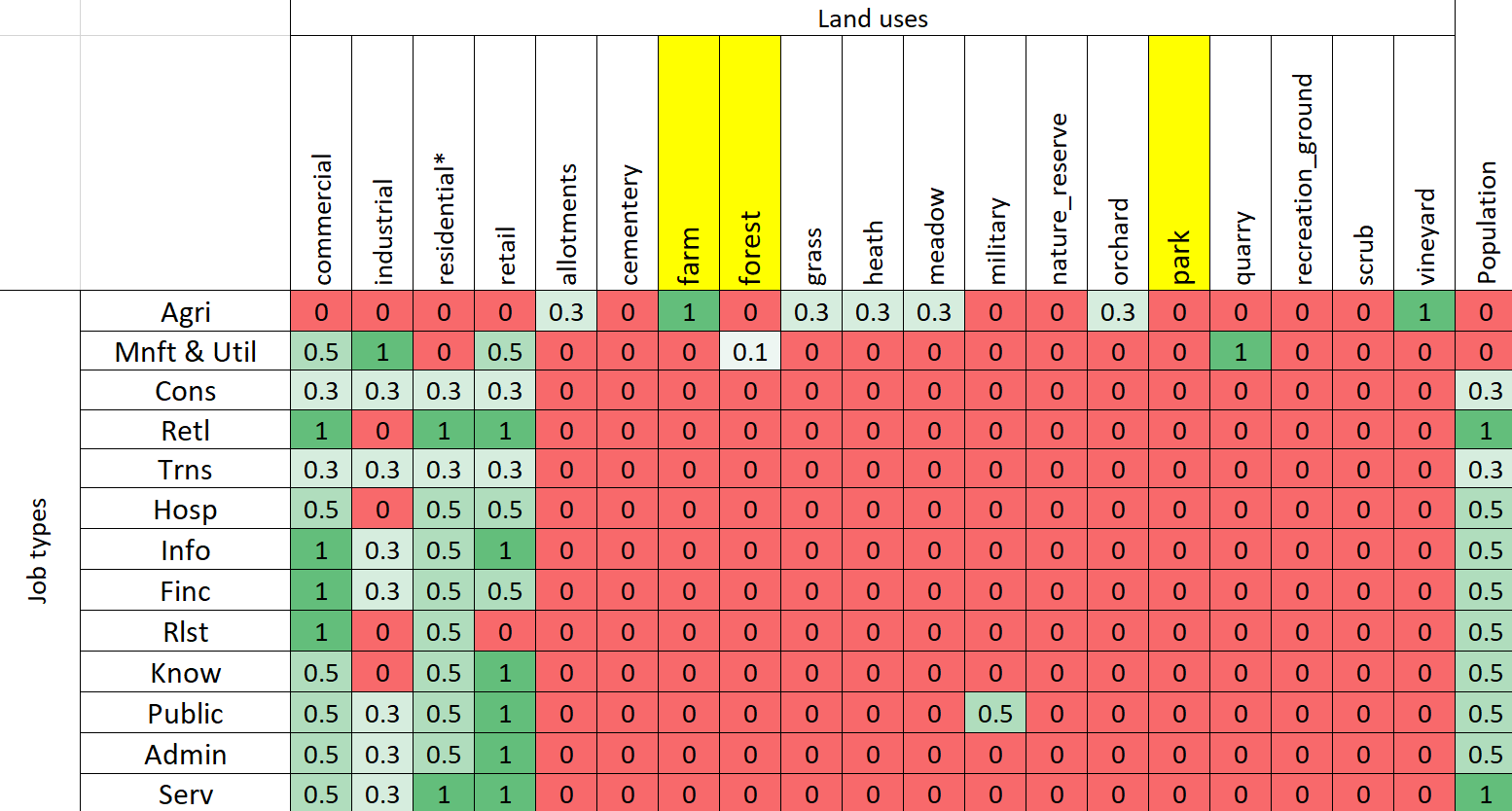
The OSM land use data is used to allocate jobs (and perhaps further applications in the future).
The OSM land use data was selected as the resolution is higher than the Corine Land Cover data available in https://gdz.bkg.bund.de/index.php/default/digitale-geodaten.html (although the main disadvantage is also its too detailed resolution, and the fact that some land uses overlap). At a first look, the quality of both sources is the same - maybe the first one is imported from the second?
The process explained here converts the osm land use polygons to a land use "intensity" (see later an accurate definition of this) to each 100x100 m raster cell in Germany (consistent with the Zesus 2011 data). The following steps are done:
- Download shapefiles of land use polygons from osm Geofabrik.
- Filter every land use type and merge different pieces (in this case, they were Federal States).
- For each land use:
- Convert polygon shp to a raster geotiff with 10 m resolution (this step was done because the intersection of polygons - more accurate - would take too much time). The process will lose accuracy, as it depends on the value of the point of a 10 m grid - so polygons smaller than that can be ignored, or overrepresented. Visually, for the application of job allocation, this should be sufficient.
- Convert geotiff raster file to point data stored as csv.
- Assign to each 10 m grid point a 100 m raster cell.
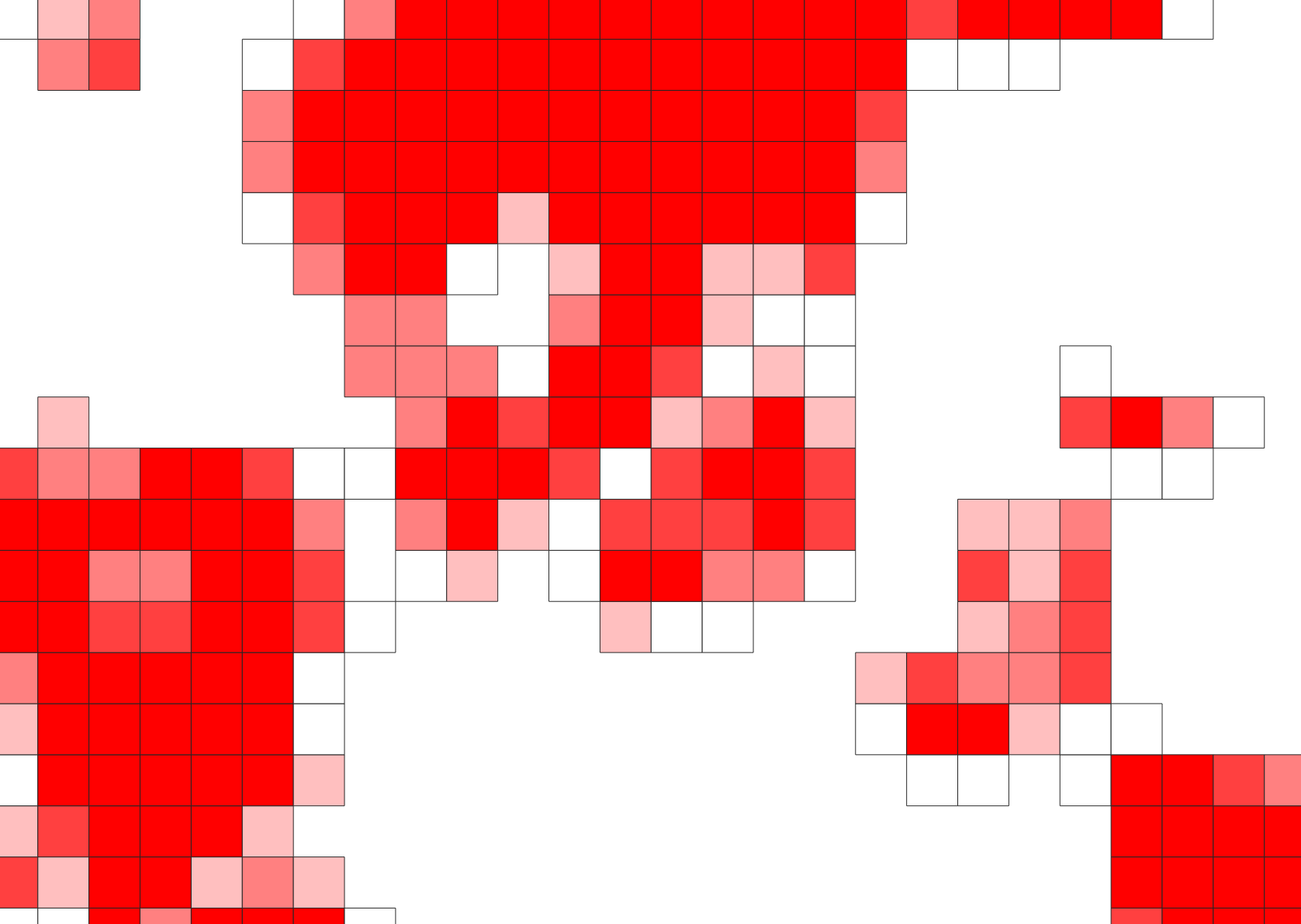
- Group by 100 m raster cell and count how many points are inside. The value ("intensity" between 0 and 100) says the percentage of area of the 100x100 m raster cell covered by this land use.
- Finally, all land uses are merged into a table, where rows are raster cells (35 Million in Germany, at 100x100 m2, make the total of 350,000 km2).
- During the step 4, the model TAZs were also assigned to each raster cell, so they can be used later to disaggregate the jobs from TAZ to 100x100 m raster.
There are cells without any land use - probably natural areas or agricultural uses. There are some overlap between land uses, e.g. park and forest sometimes overlap.
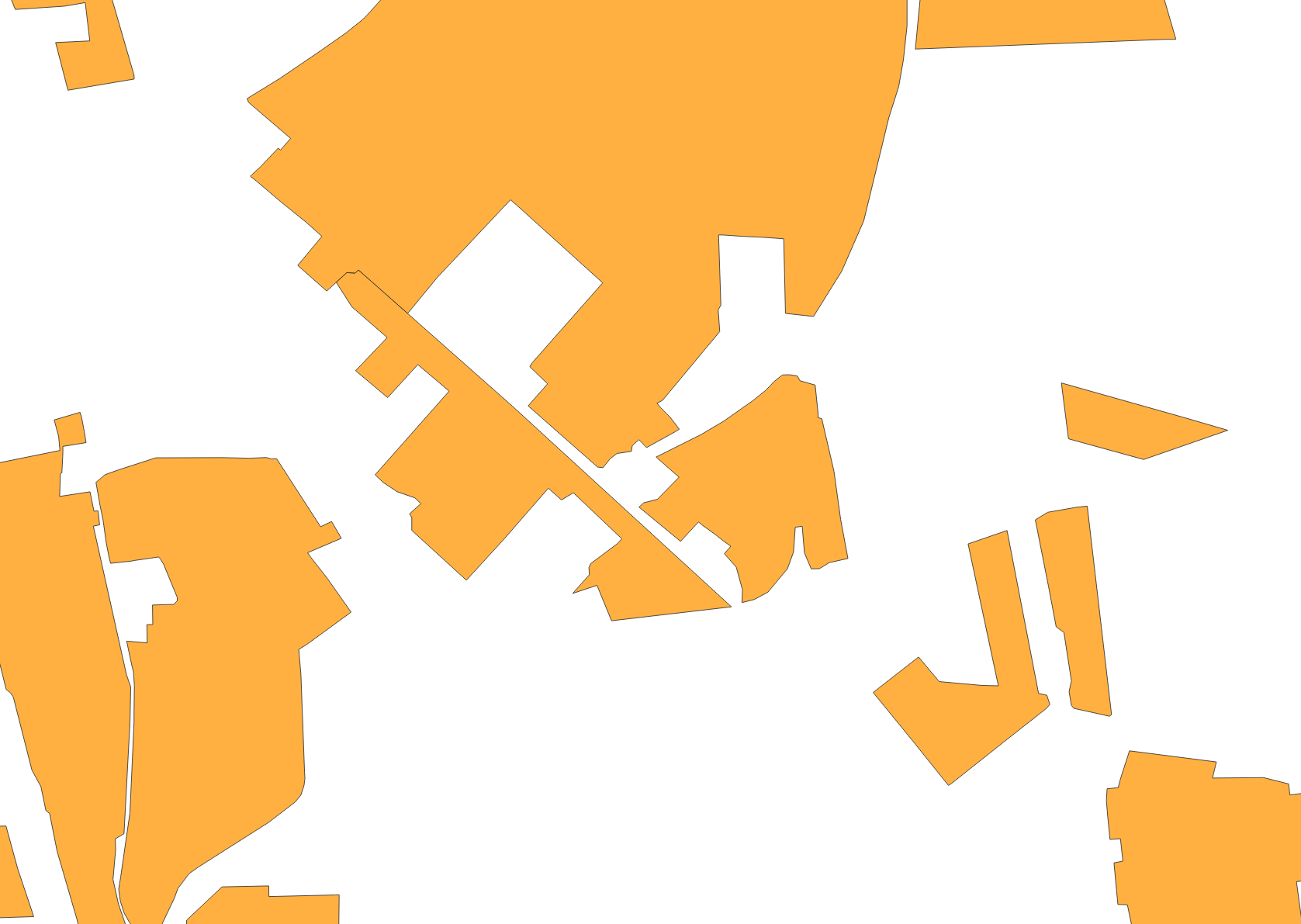
Some figures about the process (a) original polygons (b) rasterized data with 10 m resolution (c) raster cells with land use intensity (red = 100% of the cell is covered by the land use, white: less than 20% of the cell is covered by the land use)

The code used for this process is in https://github.com/cllorca1/read_zensus and in the R scripts attached. Questions and itermediate files please ask Unbekannter Benutzer (gu68goj).
Source files are the land use shp from geofrabrik and the 100x100 m raster cells from Zensus 2011.
 read_cells_and_assign_lu.Rresults_analysis.Rzones_and_lu.Rosm_lu_filter.R
Assignment of jobs
Given the land use intensity, we can allocate a certain amount of jobs whithin a model TAZ. This will be done by randomly sampling a 100x100 m raster cell that belongs to the TAZ, and the sampling is weighted by a compatibility factor between land use (column) and job type (row), where 0 means "it cannot be there" and 1 means "it is totally possible to find a job there".
The table is under preparation (28.07.2020):